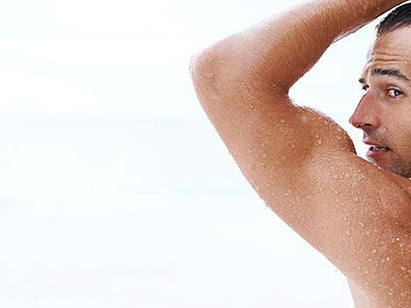
Deodorants
“What’s all the sweat about?”
One of the most common personal hygiene issues concerns a process that is absolutely
essential for human life and yet which is perceived by many to be undesirable and
dirty. This process is called perspiring or sweating, and it plays a vital role
in maintaining normal health. Amongst the essential functions of perspiring are
the elimination of toxins, maintaining the balance of salt levels, and the regulation
of body temperature.
Under normal circumstances we are all continually perspiring, losing around one
or two pints of liquid a day through our skin. Generally, this evaporates very quickly,
and our skin and clothes do not feel or appear to be damp. However, if we exert
ourselves by exercising energetically perspiration increases and we realise that
we are sweating. The same effect can be achieved through the release of adrenaline
due to fear or worry, or because we are in an environment that is too warm for the
body.
Experiments have shown that perspiration is almost odourless when fresh, but when
allowed to remain on the skin it develops the well-known sweaty odour commonly referred
to as BO. Much of this is due to the presence of bacteria that breed in the warm,
moist, nutrient-rich conditions created by perspiration. For many years man has
been looking for ways to prevent or overcome this smell, and this has lead to the
introduction of three main product categories – perfumes, deodorants and antiperspirants.
Mask that Smell!
The use of sweet smelling plants and herbs goes back thousands of years and was
once the main method of counteracting noxious odours. Some of these plant materials
were very highly prized – of the three precious gifts presented to the infant Jesus
by the Wise Men, two were perfumes – Frankincense and Myrrh. In more recent times,
but before regular washing became the norm, those who could afford to carried with
them a small, specially prepared bouquet of herbs and flowers. Called a nosegay,
the principal function of this was to disguise or mask any unpleasant smell that
might be encountered during social occasions, i.e. when meeting other people. As
we now realise, simply masking a bad smell does not make it go away and does nothing
to remove the cause, which is why there is so much interest in our second category
- deodorants.
Prevent that Smell!
With our increasing knowledge of microbiology and a greater understanding of how
some smells are caused it was only a matter of time before scientists entered the
battle against BO. Realising that much of the problem was caused by bacteria breeding
on skin and hair that was exposed to perspiration, they figured that the best approach
would be to prevent these bacteria from breeding, thereby having a deodorising action.
Various ideas were put proposed, and the first commercial deodorant was launched
in 1888. Unfortunately, in the quest for ever stronger and more effective deodorants,
stronger and more powerful chemicals started to be used.
Some of these chemicals have now been linked to health problems ranging from skin
irritation and contact dermatitis from alcohol and triclosan, to more serious problems
such as reported lung damage from zirconium salts in some deodorant sprays. These
problems lead to more stringent laws about what can be used in deodorants, but many
consumers are still concerned about the huge range of synthetic ingredients still
used in most commercial deodorants. That these synthetic ingredients are not necessary
we shall see later in this article.
Plug the Gap!
The most recent weapons created in the fight against BO were developed in the last
50 years and are known as antiperspirants. Looking at the root cause of the problem,
it seems obvious that if you cut off the supply of nutrients needed by the bacteria,
they will stop multiplying and the problem will cease. Based on this theory, a range
of chemical antiperspirants was developed to physically prevent sweat from being
excreted. Most antiperspirants contain ingredients which react with protein molecules
present in perspiration and swell to form a gel-like substance. For these to be
effective, it is important that their molecular size is small enough to allow them
to enter skin pores so that when they swell and turn to a gel, they effectively
block the pores and prevent sweat from being secreted.
Amongst the ingredients that have this property and which are commonly used in antiperspirants
are Aluminium chlorohydrate and Aluminium zirconium chlorohydrate. These are both
based on aluminium and, like most aluminium salts, they can cause skin irritation.
Unfortunately, the inflammation they can cause may spread beyond the areas where
the antiperspirant is being applied, leading to more general inflammation. Antiperspirants
also have another down-side – not only can they cause the problems mentioned above,
but they also prevent the body from eliminating toxins through perspiration, and
greatly reduce our ability to regulate body temperature. With three good reasons
to avoid antiperspirants, it is no wonder that more and more people are looking
for more natural ways to prevent body odour.
What’s the Alternative?
One of the most interesting ingredients used in controlling body odour is a naturally
occurring mineral salt called Alunite. Otherwise known as Ammonium alum, this is
an abundant earth mineral and, along with other forms of alum, forms about 8% of
the earth’s crust. It is found in small quantities in many of the foods we eat,
and is considered as very safe in personal care and other external uses. It should
be noted that whilst Ammonium alum does contain some aluminium, it is bonded into
a molecule that is physically too large to penetrate the skin. This is because
the largest molecule that can penetrate the skin has a molecular mass of less than
500 Da, whereas Alunite has a molecular mass of 670 Da - much too large to be able
to pass through the skin. Therefore, this ingredient will not block pores nor cause
skin irritation in the same way that the aluminium salts mentioned in connection
with antiperspirants can.
When Ammonium alum is applied to the skin it acts as a coagulant, constricting protein
and thereby reducing the ability of bacteria to thrive. It is not such a powerful
antibacterial as some synthetic substances used, but when applied regularly to freshly
washed skin it is remarkably effective.
Another interesting ingredient is Zinc ricinoleate. This is the zinc salt of ricinoleic
acid, extracted from the seeds of the castor oil plant. Zinc ricinoleate does not
inhibit normal perspiration, and will not interfere with the natural flora of the
skin. Instead, it ‘fixes’ the odours produced by bacterial decomposition in sweat
so that they cannot be released into the atmosphere and cause the characteristic
sweaty smell.
Green People Products
Green People use Zinc ricinoleate together with a solution of Ammonium alum in their
range of four roll-on deodorants. Using bases of organic floral waters such as Rosemary,
Lavender and Peppermint, these are available in ranges for both men and women. Used
together with good basic hygiene, all of these offer safe, natural control of body
odours without suppressing the vital function of perspiration.
View Green People's range
of natural deodorants now.
By Ian Taylor
© 2002 - The Green People Co Ltd - All Rights Reserved